Disposing of leftover cleaning products through local guidance
Leftover cleaners need a disposal route based on the product and your local service. Empty packaging and a bottle containing product may belong in different streams.
Identify before moving it
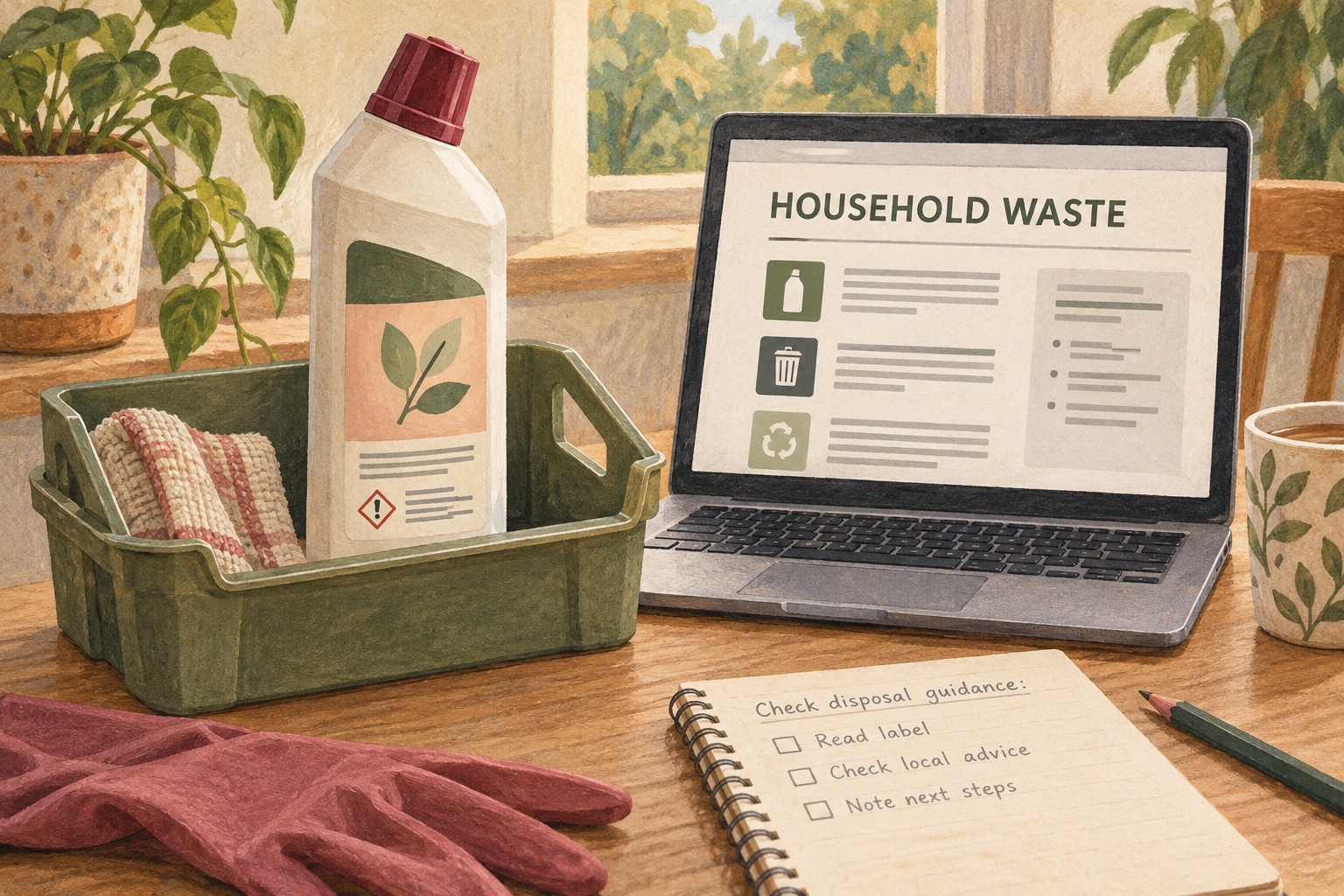
Keep the original label and note how much product remains. Do not smell an unknown chemical closely or combine small leftovers to make transport easier. If a container is damaged or leaking, contact the relevant local service for handling advice before taking it anywhere.
EPA describes certain household leftovers that are corrosive, reactive, flammable or toxic as household hazardous waste. The collection arrangements are local, and the terminology and available services differ between countries and councils.
Ask about the exact product
Check the product’s disposal directions and your local authority or waste service. Describe the cleaner, quantity and container condition. Ask whether a household chemical collection, booked appointment or another route is required.
Do not assume that a recycling centre accepts all chemicals simply because it accepts empty plastic bottles. Some facilities have limits, booking requirements or exclusions. Confirm before travelling rather than leaving an unsuitable item at the gate.
Keep transport and storage controlled
Until collection, keep the product securely in its labelled container as directed. Do not transfer it into a drink bottle or a container whose material may be incompatible. Follow the service’s packing and transport instructions, including keeping products separate where required.
Never pour unwanted products together. A disposal container can create the same mixing hazard as a cleaning bucket. Do not burn, dump outdoors or pour product down a drain merely to empty the packaging; use the instructions applicable to that product and locality.
Distinguish empty from nearly empty
A pack with a small remainder is not necessarily treated as empty. Ask what the local scheme means by empty and whether rinsing is permitted or required. Do not rinse a hazardous product into a drain simply to make its container appear recyclable.
For future purchases, choose a quantity that matches the task and storage space. Keep a simple list of what is already in the cupboard so duplicates are less likely. Disposal is easier when the product remains identifiable and the amount never grows beyond a manageable household supply.