What a safety data sheet is for
A safety data sheet provides structured chemical information. It is not a consumer product ranking, a complete recipe or a finished assessment of your particular task.
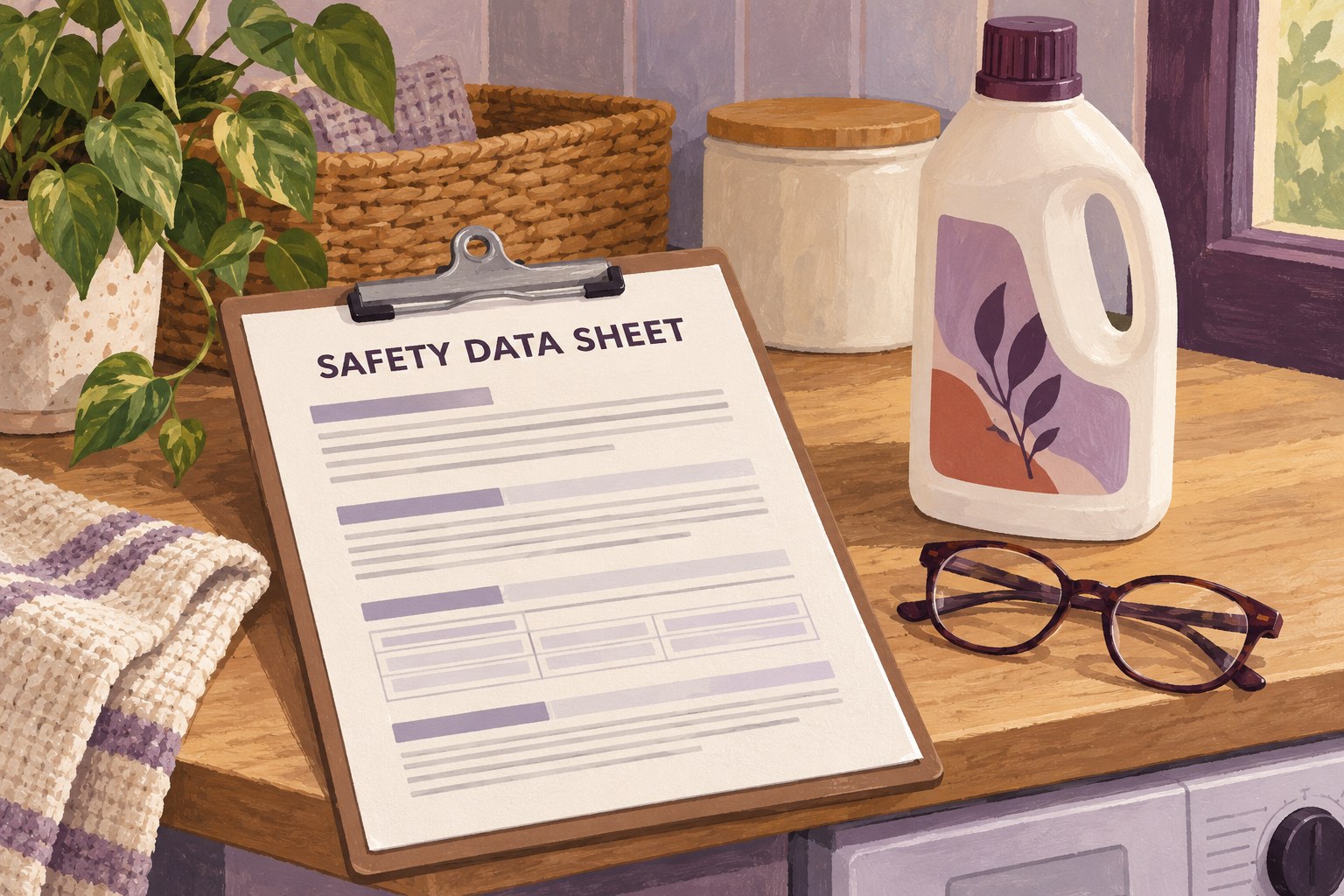
Check that the document matches
Start with the product identifier, supplier, country or regulatory context and revision date. A sheet for a similarly named industrial cleaner may not describe the retail product in your cupboard. A fragrance variant or concentration change can also matter.
Download the sheet from the manufacturer or an identified supplier where possible. If a retailer hosts an old document, ask for the current one. Keep the original product label too: the sheet is supplementary information, not a reason to discard the directions attached to the bottle.
Use the structure to find the question
Safety data sheets commonly use a numbered structure covering identity, hazards, composition, first aid, fire, accidental release, handling and storage, exposure controls, physical properties and other information. You do not need to read a technical value as if it were a shopping score.
For an ordinary handling question, the relevant sections may concern precautions, protective equipment and incompatible materials. For a spill, emergency guidance matters. For storage, look at conditions and incompatibilities. Read related sections together rather than copying one alarming sentence without its context.
Understand why the ingredient section is incomplete for some purposes
An SDS is designed for chemical hazard communication. Its composition section is not necessarily a full cosmetic-style ingredient declaration or a precise formulation recipe. Concentration ranges and disclosure rules can differ from the information a shopper expects on a retail pack.
Therefore, absence of an ingredient from an SDS is not automatically evidence that it is absent from the product. If you need to check a known allergy or a specific formulation claim, ask for the appropriate product information. Likewise, a broad concentration range does not permit a consumer to reconstruct or dilute a formula independently of its instructions.
Do not mistake the sheet for the assessment
HSE explicitly distinguishes a safety data sheet from a risk assessment. The document does not know the size of your room, who is present, how you will apply the product or whether your gloves are compatible. Those task details affect the controls needed.
Imagine a sheet describing eye irritation and specifying protective measures for handling a concentrate. Reading it tells you something important about preparation, but not whether a particular spray bottle or household routine is acceptable. You still need the product’s intended-use directions and, if unclear, the supplier’s advice.
Workplace users may have formal assessment duties beyond ordinary household decision-making. A saved PDF does not, by itself, meet those duties. Use the relevant occupational guidance and competent help for that setting.
Read the revision history when something changes
A new date on a safety data sheet can reflect a regulatory update, contact information or a substantive change. Do not assume that every revision means a formula became more dangerous, or that a familiar product name means nothing changed. Read any revision notes and ask the supplier about the point that affects your use.
Keep the current sheet for the product you actually possess. An archive can be useful for traceability, but place obsolete copies separately so another person does not follow them by mistake.
Ask a question the supplier can answer
Provide the exact product, task and point of uncertainty. For example, ask which glove specification is suitable for the stated dilution and expected contact, or whether a particular storage container is permitted. “Is it safe?” is usually too broad to resolve a practical problem.
If the label and sheet seem inconsistent, do not choose whichever instruction is easier. Ask which version applies before use. Keep the reply and current document together so that another user does not rely on the outdated version.
An SDS can be valuable precisely because it exposes questions that marketing does not answer. Its usefulness comes from matching the information to a real task, not from counting warnings or treating the document as proof that a product is either harmless or unacceptable.