Reusable baking mats: fit and manufacturer instructions
Measure the flat part of your baking tray before buying a reusable mat. A mat that curls up the sides may not be the right size for the job.
Fit the tray and the cooking method
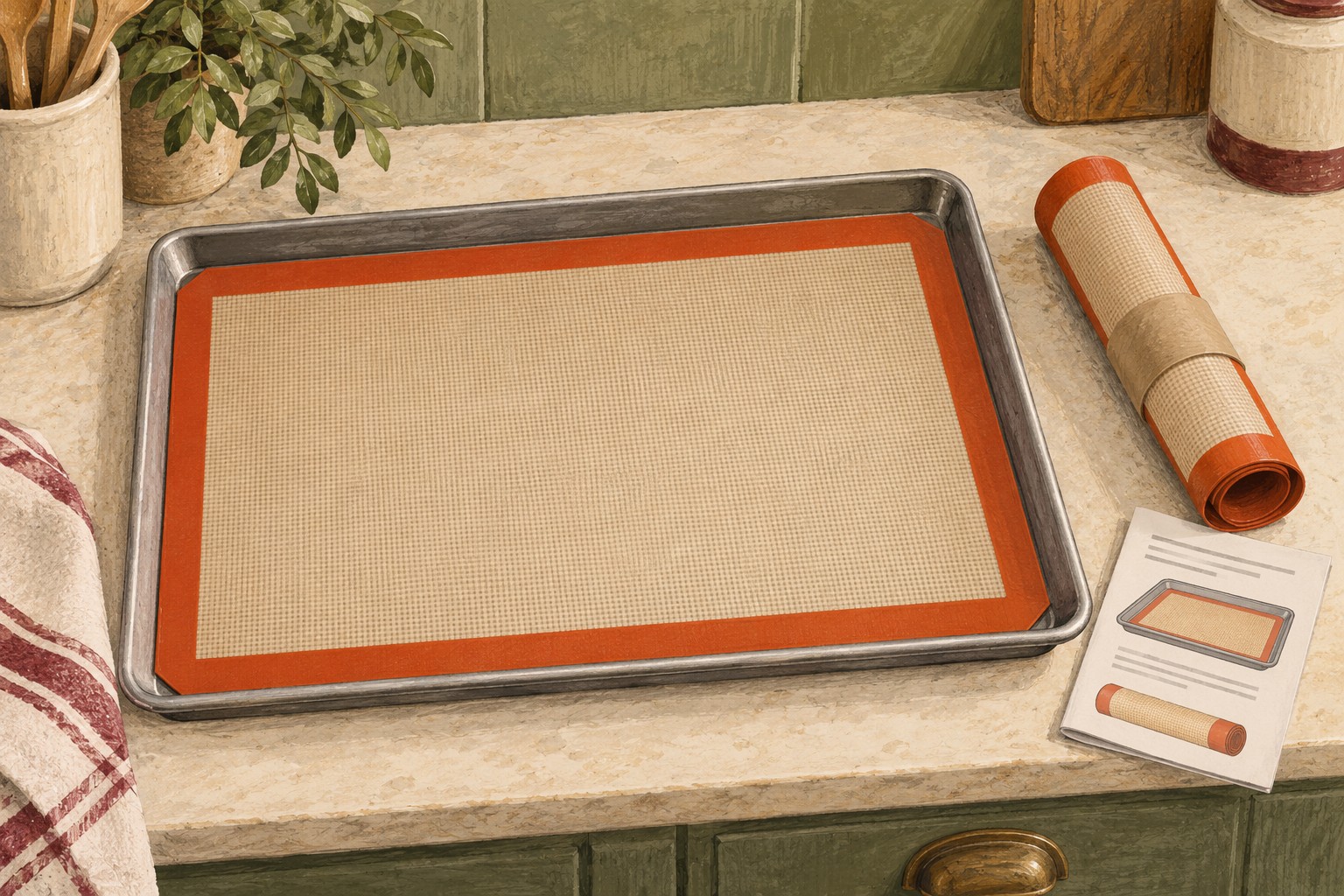
Compare the mat's dimensions with the usable inside base of the tray, not the tray's outer handles. Check whether the maker requires a supporting sheet pan. A flexible mat is not necessarily intended to carry food unsupported, and it should not be treated as a rigid baking tray.
Do not trim a mat unless the manufacturer explicitly says it may be cut. Some mats contain reinforcement, and cutting changes the finished edge. Buying the correct size is preferable to assuming that every silicone product can be altered with kitchen scissors. Check the shape too: rounded tray corners can reduce the area available for a rectangular mat.
Read the actual temperature range, oven-mode restrictions and food-use instructions. The presence of silicone does not establish one universal rating. A pastry work mat used for rolling dough may be different from an oven liner. A mat intended to sit on a tray should not be moved to the oven floor or placed against a heating element.
The mat can change how a recipe behaves compared with bare metal or paper. Use the recipe and manufacturer guidance and observe the food rather than assuming the same appearance at exactly the same minute. This is a cooking-performance consideration, not evidence of a chemical problem.
Keep sharp knives and pastry cutters away from a mat that is not designed as a cutting surface. Transfer baked food to a suitable board before slicing. Where the mat is reinforced, visible cuts or exposed material are reasons to stop use and ask the maker about replacement.
Wash and store without introducing damage
Use the permitted washing method and a soft tool if specified. Clean both sides, rinse and dry before storage. A large mat needs enough sink or worktop space to clean without folding it tightly around sharp objects. Follow the maker's advice about dishwasher use rather than inferring it from another product.
Store flat or rolled where instructed, without creasing it beneath heavy pans. Inspect it when taking it out after a long interval. A reusable mat is worthwhile when its size, cleaning and storage suit your baking frequency; if it is awkward to maintain, a smaller number of correctly sized liners may serve you better than a multipack of ill-fitting mats.