PFAS-free claims: asking what was tested or excluded
PFAS-free can refer to a broad chemical family, a manufacturing choice or a particular test. The evidence needs to match the wording and the part of the product concerned.
Start with the exact claim
Copy the wording before trying to interpret it. No intentionally added PFAS, tested for selected PFAS and PFAS-free are not identical statements. One concerns deliberate formulation, another describes a testing scope, and the broadest wording may imply more than either. Ask the supplier to explain the definition it uses.
EPA describes PFAS as a large group of chemicals used across many applications. A test for a small selection does not automatically cover every member of that family. At the same time, a detection does not by itself quantify a person's exposure or establish the risk from using the finished product. Scope and use both matter.
Find the component and version
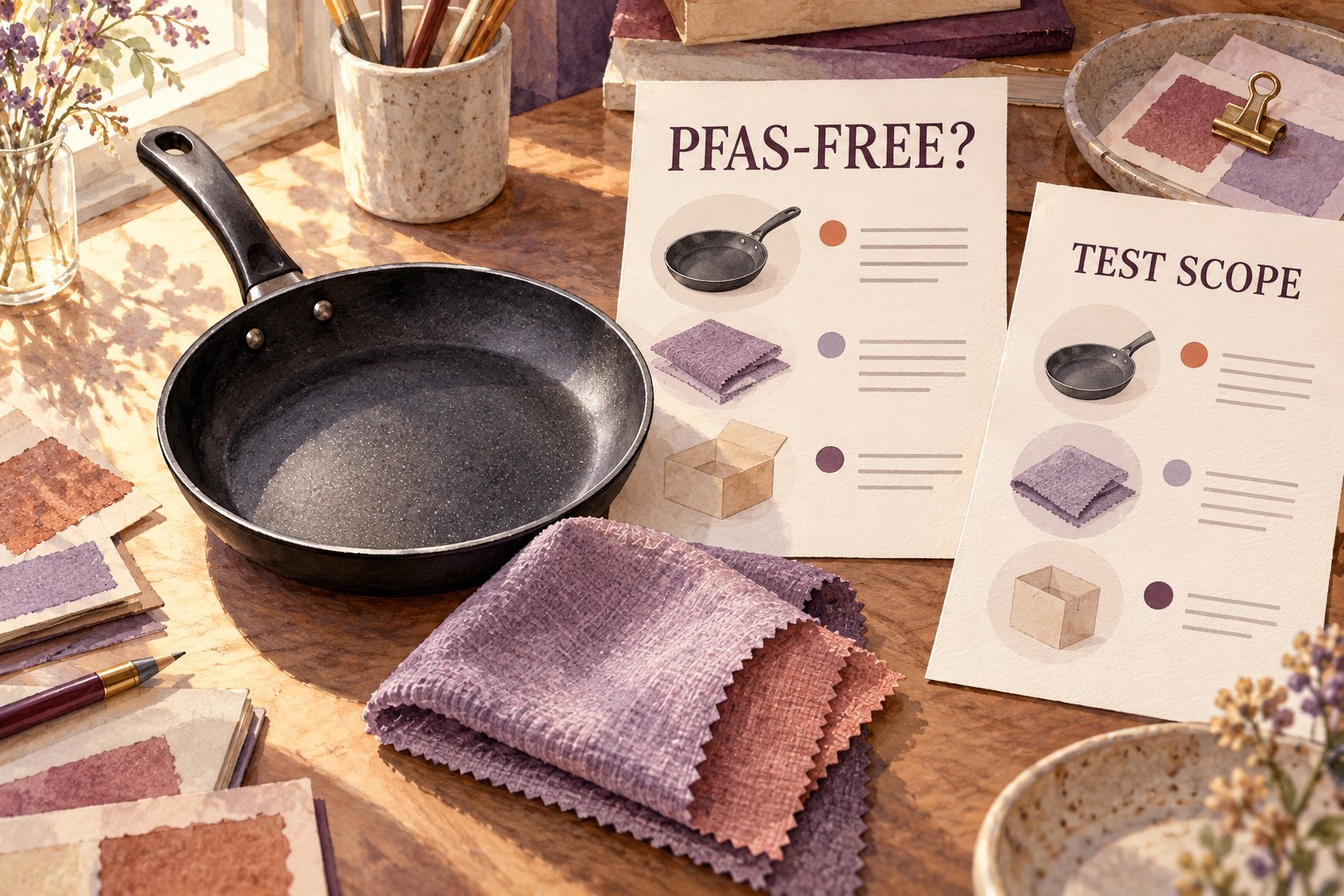
A claim may apply to a pan's cooking coating, a textile's surface treatment or a packaging layer. Ask whether it covers the complete item, including components supplied by other companies. A brand-wide statement may have exclusions or may not apply to older stock.
Match the evidence to the current product code, colour or finish where relevant. If a report tested one sample from a previous design, ask why it is considered applicable to the version now sold. Do not assume a retailer's copied description has been updated after a reformulation.
Read the testing boundary
If testing is cited, request the method, substances or measurement covered, reporting limits and sample identity. A non-detect result means the method did not report the target above its stated limit under those conditions; it is not a proof that absolutely none exists. An intentionally added statement, meanwhile, may rely on supply-chain information rather than a finished-product test.
Different screening approaches answer different questions. A targeted chemical analysis and a broader fluorine-related screen should not be described as interchangeable without technical explanation. If the report is too specialised to interpret, ask the laboratory or a qualified adviser rather than turning a single number into a home safety score.
Do not compare two reports simply by choosing the smaller result. Units, extraction conditions, tested material and reporting limits may differ. The useful comparison is whether each report supports the specific claim being made about the product you would buy.
For a hypothetical coated textile, a report might name several measured PFAS in a swatch while the shop uses a broad claim about the entire garment. The follow-up questions are whether the treatment, stitching, fasteners and current production version are covered, and what basis supports the broader wording. This is a document-scope question; it is not a conclusion that an untested component necessarily contains PFAS.
Keep use and performance separate
A PFAS-free statement does not establish that cookware may be overheated or that a textile has a particular wash life. Read the ordinary use instructions. For a pan, temperature and utensil restrictions still matter; for a waterproof garment, care and repair information remain relevant.
If avoiding a particular treatment is your preference, ask for a clearly defined formulation statement and choose a product that also does the job. There is no need to claim that every alternative is harmless or that any product without a visible label is dangerous. Missing information is an uncertainty, not a laboratory finding.
Avoid home experiments intended to identify a coating by burning, heating or treating it with solvents. They do not provide a reliable consumer analysis and can introduce hazards unrelated to ordinary use. Manufacturer documentation and competent testing are the relevant routes when composition needs to be established. If those routes do not resolve an essential preference, choosing another clearly described product is reasonable.
Keep the answer attached to the product
Save the dated statement or report with the model reference. Recheck when a product is redesigned or when buying a different variant. If a supplier cannot explain the claim, consider a product with clearer information rather than rewarding the most absolute wording.
This approach keeps a useful purchasing preference from becoming a promise of zero exposure across the household. Exposure can have multiple sources, and a label on one item cannot assess them all. The immediate decision is whether the evidence supports the particular claim and use under consideration.