OEKO-TEX STANDARD 100: what the textile label covers
OEKO-TEX STANDARD 100 concerns textiles tested against the scheme’s substance criteria. Verify the certificate and the product scope before expanding the claim.
Identify the named standard
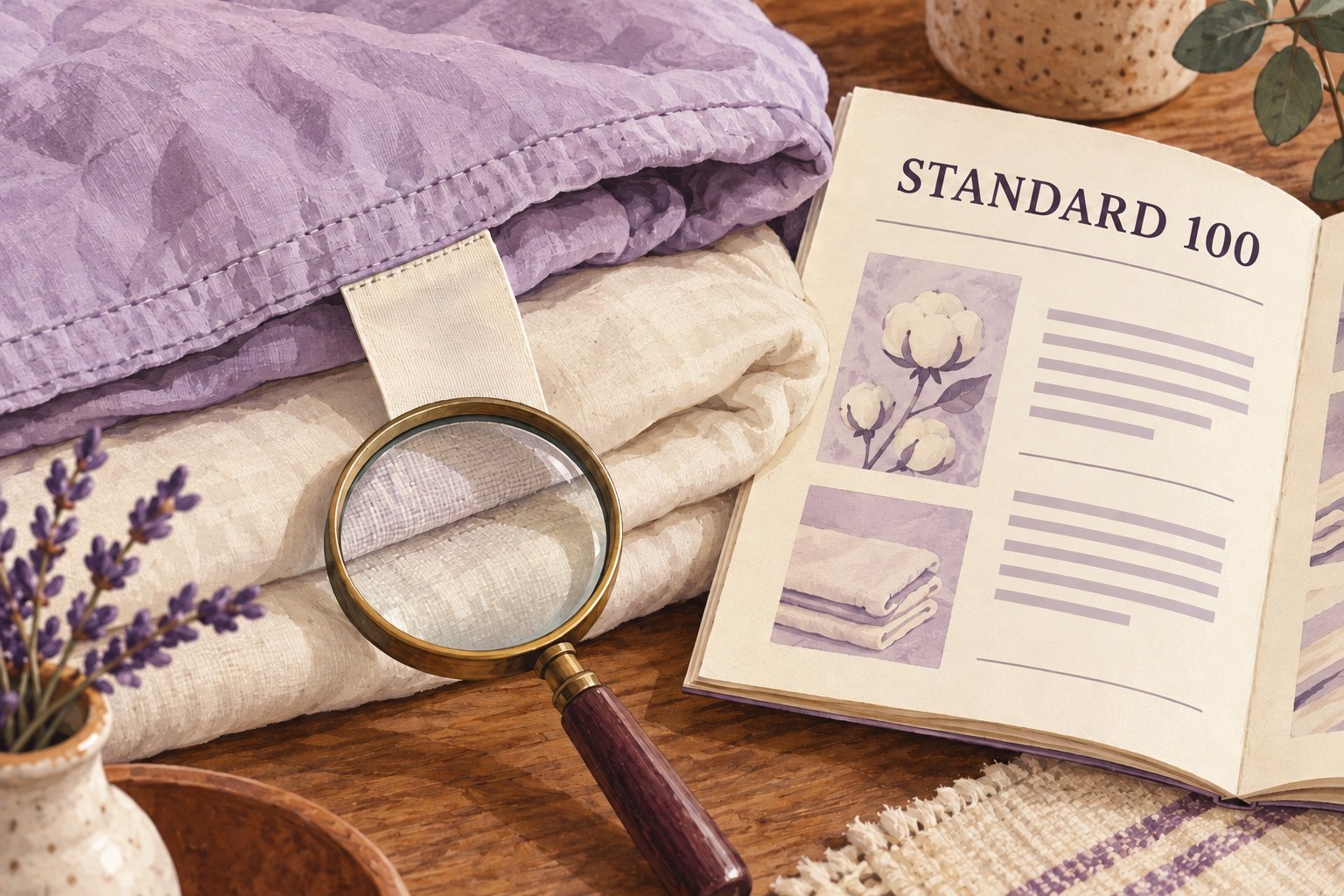
OEKO-TEX operates more than one programme. Read the full name on the label rather than treating every OEKO-TEX mark as interchangeable. STANDARD 100 is the textile testing label discussed here; a different programme can address different aspects of production or sourcing.
Look for the certificate or label number and the testing institute information where supplied. A general sentence that a brand uses certified fabrics may refer to a component, not necessarily the complete finished item you are buying.
Use Label Check
Enter the number or use the label’s QR code through the official OEKO-TEX checking service. Compare the result with the seller’s description, certificate holder and product scope. Keep the exact number in your notes rather than relying on a logo screenshot without identification.
If the result is unclear or does not match, ask the seller for the current certificate information and clarification. A typo, outdated document or component-level claim may explain a mismatch, but it should be resolved before you describe the whole item as certified.
Do not treat a certificate for one supplier or fabric as automatic coverage for all products in a shop. A finished item can include thread, prints, zips, coatings and other components, and the certified scope matters.
Understand the claim’s limits
STANDARD 100 concerns testing for harmful substances against defined criteria and limits. It does not mean that a textile contains no chemicals, that every substance is absent at any detectable level or that nobody could have an individual reaction.
It is also not, by itself, a statement that the fibre is organically grown, that a product is vegan, that all labour conditions meet a particular programme or that the item will last a certain number of years. Those are different claims requiring different evidence.
Product categories and intended contact can affect the applicable requirements within a scheme. Read the programme explanation and certificate scope rather than assuming that one number gives a universal ranking for every textile use.
Continue with the ordinary buying checks
For bedding, check size, fibre composition, care requirements and whether your machine can wash and dry it as instructed. For a protective cover, check the fit and closure. For a towel, consider the intended washing routine. Certification does not answer those practical questions.
Do not discard care labels after finding a certification mark. The product still needs the intended maintenance. A textile that is difficult to dry in your home may be a poor choice even when its certificate is current.
If an allergy is the concern, seek ingredient or material information specific to that allergy and professional advice where needed. A broad textile certificate cannot substitute for an individual medical assessment.
A component claim needs precise wording
Suppose a cushion description says its cover fabric is certified. That does not necessarily describe the filling, zip or complete assembled cushion. Ask which product the certificate covers, and keep the answer attached to that scope.
This does not make the component claim worthless. It can be useful information about that fabric. It becomes misleading only when a reader or seller silently expands it to parts that were not identified. A precise purchase note can preserve the value without making the larger claim.
Describe a verified purchase accurately
You might record that a particular item’s STANDARD 100 certificate was checked and matched its stated scope on the purchase date. Avoid changing that into “completely non-toxic” or “organic” unless separate evidence supports the additional claim.
For online shopping, ask whether the whole product or a named fabric is certified when the wording is vague. That question can resolve the issue without demanding unrelated manufacturing information. Keep the reply with the order details.
Recheck when buying a different model, colour or material variant if the certificate information does not clearly include it. A consistent brand appearance is not proof that every version has the same certification scope.