Buying second-hand cookware with enough information
Second-hand cookware can be worth considering when its identity, condition and care requirements are clear. An attractive price cannot supply missing information.
Ask for the working surfaces
Request photographs of the dry interior, base, rim and handles, not only the exterior colour. Ask for the manufacturer, model and approximate age if known. A maker's mark can help locate care instructions, hob compatibility and replacement parts. If a lid belongs to another model, check it separately rather than assuming the pairing is approved.
Look for distortion, loose handles, damaged coatings, cracks and chips. A seller's description of normal wear is not a technical assessment. Ask what cleaning or restoration has been carried out, especially if an old pan has an unusually fresh coating. Household paint or an unidentified repair is not evidence of a food-contact finish.
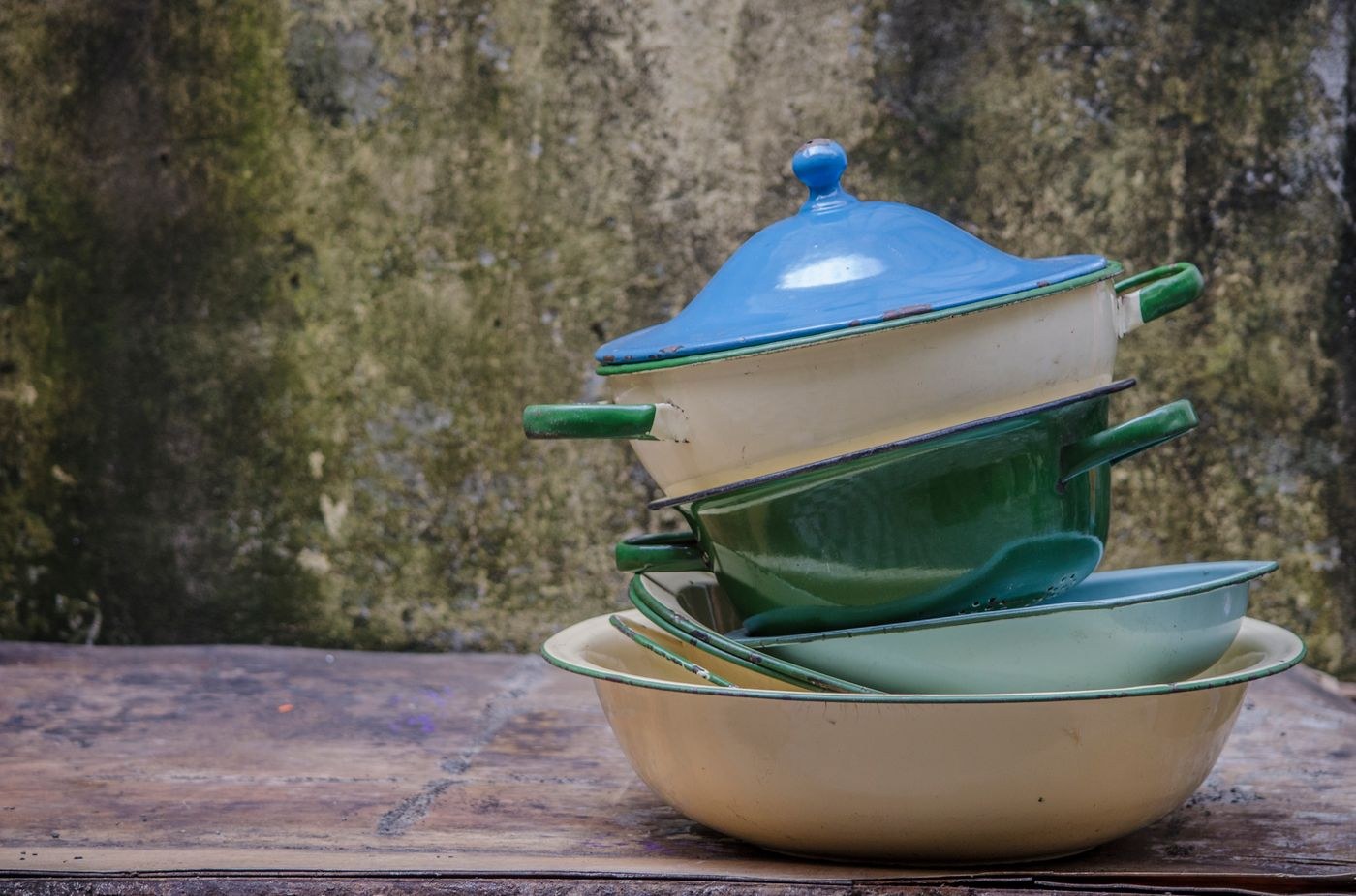
For an enamelled pot, a dry close-up of the interior is more informative than a photograph with water or oil inside, which can obscure marks. For a frying pan, ask for a view of the base resting on a flat surface and details of any loose handle. These requests are about observable condition, not a remote guarantee. If the seller cannot show the working surfaces clearly, include that uncertainty in the decision rather than assuming the unseen areas are sound.
Consider what you cannot establish
Vintage pottery and decorative vessels may lack the information needed for cooking or food storage. Do not infer food suitability from a bowl shape or from the fact that an item was displayed in a kitchen. Health Canada's cookware advice distinguishes decorative pieces and highlights concerns with some glazes and coatings. An unknown history can be a reason to use an object decoratively, not a challenge to solve with a home scratch test.
For a recognisable product, search the manufacturer's advice and the recall database for the market where you live. Match the model and relevant batch details, not just the brand name. A recall check cannot establish that an individual used pan has been well cared for, but it can identify a known issue that photographs will not reveal.
Pressure cookers and electrical cookware need more information than a simple saucepan. Missing valves, seals, wiring information or instructions warrant particular caution. Do not improvise replacement safety components or assume a seller's demonstration proves future safe operation.
Separate an item that needs ordinary cleaning from one that requires restoration. A stainless saucepan with removable food residue is a different proposition from a coated pan that has been sanded or repainted. Ask what products were used in any restoration and whether the manufacturer supports them. Do not accept a polished appearance as evidence that a food-contact surface has been restored appropriately.
Include care and replacement costs
Add the cost of a genuine compatible lid, handle or seal before comparing the price with a new item. Confirm that replacement parts remain available. A pan that requires an unfamiliar restoration process may not be a useful saving for someone who simply needs to cook dinner.
Clean the item using its supported method before first use. If damage appears during that process, stop and seek advice rather than escalating to stronger chemicals. Keep the seller's description and your photographs with the product information. The goal is a usable piece of cookware with a known role, not the largest possible collection of bargains.
Make a simple total-cost comparison: purchase price, transport, necessary parts and any assessment or restoration you cannot do yourself. Add the time needed to locate instructions. If the combined cost approaches a new suitable pan with clear care information, the second-hand option may offer little advantage for your particular need. If the item is well identified and intact, its existing condition may make it a useful purchase without needing any dramatic refurbishment.